Showing posts with label alcohol moderation. Show all posts

Thursday, July 11, 2013

6 Days Left! -- 183 lbs (-46) [8X]


I am so looking forward to being done with this year-long diet. Regardless of whether I reach my goal of weighing 180 pounds by the 17th (which is looking barely possible), I will stop tracking what I eat, drink, and weigh on that day. I don't know if I'll try to maintain a healthy weight (which for me means staying under 200 lbs), but I suspect I will eat a little more and drink a little less, on average. I will continue to maintain this blog for at least another year, fighting the good fight (the right to drink in moderation 24x7) and occasionally posting bottom-shelf reviews.

[+] What I Consumed Since Last Post ...

Wednesday, June 19, 2013

BMI Death Calculator -- 189 lbs (-40) [38X]


Of all First World problems, none seems to take so much time and energy as fussing about weight. Medical science, for instance, has done so many studies on BMI that it is having to do studies of those studies--and even those draw different conclusions. Pretty much all studies confirm that people who are extremely underweight (< 16 BMI) or extremely overweight (> 35 BMI) have greatly increased death rates, but the results for people in the overweight range (25 to 30 BMI) vary from small risk to increased benefit--the trend being towards the latter. A study in 2010 of 19 other studies found that, for white adult males at least, being mildly overweight was best. An even more recent study in 2012, of 97 unique studies, concluded that overweight and grade 1 obesity classifications were optimal for all-cause mortality (and was widely covered in the media).

For your own morbid fun, you can see where yourself and others might have fared in the 2010 study here:

BMI: ?

Hazard Ratio: ?

This person is classified as ?

This person is probably around ?% more at risk of dying based on their weight and height

Please note these results are normalized across a large number of variables such as age, health, and lifestyle, so they should be taken with a "grain of salt". For instance, the same study found that moderate alcohol consumption was associated with decreasing death rates for increasing BMI (for non-smokers). Stated differently, overweight drinkers that don't smoke tend to live longer.

[+] What I Consumed Since Last Post ...

Thursday, April 11, 2013

A is for Anesthesia -- 185 lbs (-44) [28X]


We're born--we struggle to live in this turbulent, fast-paced world for a short while--and then we die. In the process, when we're not hurting each other, we help dismantle the universe by using energy and materials that can never fully be replaced. This is the operation of life, for which alcohol is the anesthesia (to paraphrase George Bernard Shaw). Actually, at safe blood alcohol concentrations (BAC), alcohol is more of a mild sedative than an anesthetic, but we'll take what we can get. While it can function as anesthesia at dangerously high BAC levels, getting that drunk can lead to more pain and sadness in need of more anesthesia--a vicious cycle that is not worth it. Besides, most of us don't want to eliminate pain and sadness at the expense of pleasure and happiness, right? Personally, I just want to take the hard edge off so I can focus on doing the best I can with my tiny share of the universe's energy and materials.

[+] What I Consumed Since Last Post ...

Thursday, March 28, 2013

I Can Drive 55 -- 185 lbs (-44) [25X]


While Sammy Hagar can't drive 55, I can and do-- .055 BAC (Blood Alcohol Content) that is. In 1982, Roger Volger and Wayne Bartz published one of the first low-dose alcohol programs in a now out-of-print book called "The Better Way To Drink".
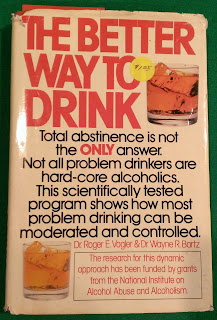


Their primary guidance was to "savor the good effects as your blood alcohol is rising up to a maximum of 55 and then quit drinking", as costs and risks begin to outweigh benefits above .055 BAC:

● The good feelings produced by alcohol decrease above a BA of 55 for most drinkers
● Impairment of physical functioning such as coordination accelerates above 55, along with the risk of all sorts of accidents
● The negative effects on physical health are considered greater above that level
● Emotional control becomes more unpredictable above 55
● Stress relief ends above 55 for most drinkers, and more alcohol tends to increase anxiety rather than to reduce it
● Hangovers occur mainly at BAs over 55, with their attendant negative effects on job performance, family, etc.

My personal experience is totally in line with these findings, though I tend to stay below .030. How can I drink so much and maintain a low BAC? By creating several "alcohol waves" throughout the day. An alcohol wave is created by drinking 2-6 oz of whisky (of equivalent other alcohol) over a period of 1-3 hours, and then stopping for at least a couple of hours before starting the next wave. I theorize that this provides the maximum health benefits of alcohol, without the risks associated with higher BAC. And any benefits are probably amplified by the reduced BMI that comes from substituting alcohol for bad carbohydrates.

As far as driving at 55 BAC is concerned, it's nothing to get your knickers in a twist about, despite what many folks would like you think. The majority of driving fatalities don't involve any alcohol, and the majority of alcohol-related ones occur at a BAC of .15 (aka 150) or higher. The legal limit of .08 is there for a reason-- respect it.


[+] What I Consumed Since Last Post ...

Monday, January 28, 2013

Mixing It Up -- 188 lbs (-41) [14X]


I tried fasting longer on work days last week, but I may have eaten more at night, so I'm not sure if there was a net benefit. Regardless, I macked out Friday through Sunday, once again ending up high for the week. Telling myself to pig-out less isn't going to make it happen--I need an actionable strategy to break my current okay-but-not-great seesaw pattern.

In the beginning of November, I cut wine out of my diet, and a couple of weeks later, I cut out beer. I thought that sticking only to whisky might be even more effective at weight control, because distilled liquor does not contribute any glucose to one's body. I also stopped mixing whisky, and since one can only consume about 1.5 oz per hour without getting intoxicated, drinking it straight-up leaves plenty of spare time for eating. Plus, it is not a good appetite suppressant by itself. When I started this diet, I had no issues mixing a cheap whiskey like Evan Williams with coffee, diet soda, light beer, or even noodle broth. By getting all esoteric about whisky, I may have lost an important regulatory function that mixing liquor, or drinking lower alcohol content beverages like beer and wine, serves.

So there is my new/old strategy to try in February: stretch my alcohol across time by mixing whisky/whiskey more and welcoming light beer and wine back into my diet. That may be the actionable key to less feeding frenzies at night and grazing on weekends.

[+] What I Consumed Since Last Post ...

Saturday, October 20, 2012

The Edge Of Control -- 192 lbs (-37) [3X]

"So what is the role of alcohol in this diet?", a colleague asked yesterday. A mighty fine question for which I've done a mighty poor job of answering thus far.

A few diets, such as the Banting Diet and Drinking Man's Diet prominently feature alcohol, as well as diets that have been practiced by contemporaries such as Lady Gaga and Christian Bale, but mine is decidedly different. These other diets include food restrictions, carb and/or calorie counting, and/or exercise--none of which would work for me. Instead, I use alcohol as a tool to avoid all of these things.

As mentioned previously, I practice a form of "intermittent fasting". Usually, intermittent fasting involves consuming no calories for at least 16 hours, and while I do this sometimes, it can get uncomfortable. I find that alcohol in moderate doses does a fabulous job of turning the discomfort of hunger into an enhanced pleasure, and that whisky has a mental simulation effect beyond that. This is no secret--whisky drinkers have known this for hundreds of years. It is also no secret that alcohol in excess leads to all sorts of bad effects, the least of which is over-eating, so you can see where drinking to lose weight takes a certain amount of discipline, and is not even an option for many people's situations.

So anyone who thinks this diet is about getting drunk is mistaken. It is about riding the edge of control for maximum gain, like a tow-in surfer, formula racer, base jumper, or anyone that wants to push the limits of what is possible. But I'm not remotely as crazy or skilled as these extreme sport folks. It is rare that I pull off the perfect whisky diet day--if you go over my consumption logs you can see that I've over-eaten on many occasions--and yet, I have achieved impressive weight gains in spite of my follies. While I am certain someone more disciplined could do much better, a more rapid weight loss may be too much strain on the body, so perhaps I am striking the right balance here. Perhaps the key to a successful whisky diet is riding the crest of hunger, alcohol, and feasting--let's call it "alcohol surfing".


What I consumed yesterday:
● 2 coffee w/ 3 tbsp whiskey & 2 tsp fiber
● 3 cups syrah (I forgot to note the brand)
● 5 buffalo chicken drumettes w/ small cuts of assorted cheese
● .6 cup Lauder's scotch whisky
● 4 slices Boboli pizza w/ 3 slices bacon
● Apple slice dipped in Jif peanut butter